Build an Economics Study Buddy from a Real Textbook
In Parts 1 and 2, we used 5 hardcoded sentences. Now we’ll build something real: a study tool that searches an entire economics textbook to answer your questions.
Our knowledge base is Principles of Microeconomics 3e from OpenStax — every answer is grounded in actual textbook content.
Setup
import sys, os, glob, ctypes, subprocess, importlib.util
from importlib.metadata import version, PackageNotFoundError

# ---- config ----
CUDA_WHL = "https://abetlen.github.io/llama-cpp-python/whl/cu121"  # switch to cu122 if your DC CUDA is 12.2
LLAMA_VER = "0.3.16"

BASE_PKGS = ["datasets", "onnxruntime-gpu", "transformers", "huggingface_hub"]
CUDA_PKGS = ["nvidia-cuda-runtime-cu12", "nvidia-cublas-cu12"]

# Keep HF quieter / more reliable in demos
os.environ["HF_HUB_DISABLE_XET"] = "1"
os.environ["HF_HUB_DOWNLOAD_TIMEOUT"] = "120"

def have_module(modname: str) -> bool:
    return importlib.util.find_spec(modname) is not None

def have_pkg(pkgname: str, want: str | None = None) -> bool:
    try:
        v = version(pkgname)
        return (want is None) or (v == want)
    except PackageNotFoundError:
        return False

def pip_install_quiet(args: list[str]):
    subprocess.run(
        [sys.executable, "-m", "pip", "install", "-U", "--no-cache-dir", "-q", "--break-system-packages", *args],
        check=True,
        stdout=subprocess.DEVNULL,
        stderr=subprocess.DEVNULL,
    )

def pip_uninstall_quiet(pkg: str):
    subprocess.run(
        [sys.executable, "-m", "pip", "uninstall", "-y", pkg],
        check=False,
        stdout=subprocess.DEVNULL,
        stderr=subprocess.DEVNULL,
    )

# ---- 1) install only if missing ----
missing = [p for p in BASE_PKGS if not have_pkg(p)]
if missing:
    pip_install_quiet(missing)

missing_cuda = [p for p in CUDA_PKGS if not have_pkg(p)]
if missing_cuda:
    pip_install_quiet(missing_cuda)

# llama-cpp-python: ensure correct CUDA wheel + version
need_llama = (not have_pkg("llama-cpp-python", LLAMA_VER))
if need_llama:
    pip_uninstall_quiet("llama-cpp-python")
    pip_install_quiet(["llama-cpp-python", "--extra-index-url", CUDA_WHL])

# ---- 2) preload CUDA .so so import works after kernel restarts ----
cudart = glob.glob("/srv/conda/envs/notebook/lib/python3.12/site-packages/nvidia/**/libcudart.so.12*", recursive=True)
cublas = glob.glob("/srv/conda/envs/notebook/lib/python3.12/site-packages/nvidia/**/libcublas.so.12*", recursive=True)
if cudart and cublas:
    ctypes.CDLL(cudart[0])
    ctypes.CDLL(cublas[0])

# ---- 3) quick sanity line ----
print("Setup OK (deps present). If this was the first run today, restart kernel once, then run again.")
Setup OK (deps present). If this was the first run today, restart kernel once, then run again.
import os, sys
from contextlib import redirect_stderr
from llama_cpp import Llama

with open(os.devnull, "w") as fnull, redirect_stderr(fnull):
    model = Llama(
        model_path="/home/jovyan/shared/qwen2-1_5b-instruct-q4_0.gguf",
        n_ctx=2048,
        n_gpu_layers=28,
        verbose=True,
    )
# --- Cell 3: runtime imports + embedding model (no llama install here) ---
import os, time, glob, ctypes
import numpy as np
import onnxruntime as ort
from datasets import load_dataset
from huggingface_hub import hf_hub_download
from transformers import AutoTokenizer
# HF settings
os.environ["HF_HUB_DISABLE_XET"] = "1"
os.environ["HF_HUB_DOWNLOAD_TIMEOUT"] = "120"
# Preload CUDA runtime libs so llama-cpp-python can import after kernel restarts
cudart = glob.glob("/srv/conda/envs/notebook/lib/python3.12/site-packages/nvidia/**/libcudart.so.12*", recursive=True)
cublas = glob.glob("/srv/conda/envs/notebook/lib/python3.12/site-packages/nvidia/**/libcublas.so.12*", recursive=True)
if cudart and cublas:
ctypes.CDLL(cudart[0])
ctypes.CDLL(cublas[0])
from llama_cpp import Llama # now safe
# Download ONNX embedding model
onnx_path = hf_hub_download(
repo_id="sentence-transformers/all-MiniLM-L6-v2",
filename="onnx/model_O4.onnx",
force_download=True
)
# Prefer CUDA EP if available (priority order matters) :contentReference[oaicite:0]{index=0}
providers = ["CUDAExecutionProvider", "CPUExecutionProvider"] if "CUDAExecutionProvider" in ort.get_available_providers() else ["CPUExecutionProvider"]
onnx_session = ort.InferenceSession(onnx_path, providers=providers)
active_provider = onnx_session.get_providers()[0]
print(f"ONNX active provider: {active_provider}")
tokenizer = AutoTokenizer.from_pretrained("sentence-transformers/all-MiniLM-L6-v2")
def encode(texts):
if isinstance(texts, str):
texts = [texts]
encoded = tokenizer(texts, padding=True, truncation=True, max_length=256, return_tensors="np")
outputs = onnx_session.run(None, {
"input_ids": encoded["input_ids"],
"attention_mask": encoded["attention_mask"],
"token_type_ids": encoded["token_type_ids"],
})
token_embs = outputs[0]
mask = np.expand_dims(encoded["attention_mask"], axis=-1).astype(float)
emb = np.sum(token_embs * mask, axis=1) / np.maximum(mask.sum(axis=1), 1e-9)
emb = emb / np.linalg.norm(emb, axis=1, keepdims=True)
return emb
# Quick warmup
t0 = time.perf_counter()
_ = encode(["warm up the embedding model"])
t1 = time.perf_counter()
print(f"Setup complete! (embedding warmup: {t1-t0:.3f}s on {active_provider})")2026-02-26 08:15:04.639860149 [W:onnxruntime:, transformer_memcpy.cc:111 ApplyImpl] 12 Memcpy nodes are added to the graph main_graph for CUDAExecutionProvider. It might have negative impact on performance (including unable to run CUDA graph). Set session_options.log_severity_level=1 to see the detail logs before this message.
ONNX active provider: CUDAExecutionProvider
Setup complete! (embedding warmup: 0.268s on CUDAExecutionProvider)
Load the Textbook
We load ~4,000 text passages from the textbook via Hugging Face, then filter out boilerplate (copyright notices, tables of contents, etc.).
# Load the dataset from Hugging Face
ds = load_dataset("meetara-lab/vectorstore-economics", split="train")

print(f"Loaded {len(ds)} raw chunks from the dataset")
print(f"Columns: {ds.column_names}")
print()

# Let's look at what a raw chunk looks like
print("Example chunk (raw):")
print("=" * 50)
print(ds[100]["document"][:400])
Warning: You are sending unauthenticated requests to the HF Hub. Please set a HF_TOKEN to enable higher rate limits and faster downloads.
Loaded 4228 raw chunks from the dataset
Columns: ['id', 'embedding', 'document', 'metadata']

Example chunk (raw):
==================================================
often treated as a separate country. Several additional countries were not ranked because of extreme instability that

made judgments about economic freedom impossible. These countries include Afghanistan, Iraq, Libya, Syria,

Somalia, and Yemen.

The assigned rankings are inevitably based on estimates, yet even these rough measures can be useful for

discerning trends. In 2015, 101 of the 178 inc
# Filter out boilerplate — copyright notices, table of contents, contributor lists, etc.
noise_markers = [
    "creative commons", "openstax", "all rights reserved", "rice university",
    "table of contents", "contributor", "peer reviewer", "senior contributing",
    "isbn", "trademarks", "access for free", "citation information",
    "acknowledgment", "bring it home", "link it up", "clear it up", "work it out"
]

chunks = []
chunk_embeddings_list = []
for item in ds:
    text = item["document"]
    text_lower = text.lower()

    # Skip boilerplate and chunks with very few unique words
    is_noise = any(marker in text_lower for marker in noise_markers)
    too_repetitive = len(set(text.split())) < 30

    if not is_noise and not too_repetitive:
        chunks.append(text)
        chunk_embeddings_list.append(item["embedding"])

print(f"After filtering: {len(chunks)} usable textbook passages (removed {len(ds) - len(chunks)} noisy chunks)")
print()

# Use a subset to keep things fast
MAX_CHUNKS = 500
chunks = chunks[:MAX_CHUNKS]
chunk_embeddings = np.array(chunk_embeddings_list[:MAX_CHUNKS], dtype=np.float32)

# Normalize (in case the stored embeddings aren't already)
norms = np.linalg.norm(chunk_embeddings, axis=1, keepdims=True)
chunk_embeddings = chunk_embeddings / np.maximum(norms, 1e-9)

print(f"Using first {len(chunks)} chunks with pre-computed embeddings")
print(f"Vector store shape: {chunk_embeddings.shape} (no embedding step needed!)")
After filtering: 3004 usable textbook passages (removed 1224 noisy chunks)
Using first 500 chunks with pre-computed embeddings
Vector store shape: (500, 384) (no embedding step needed!)
# Let's peek at what our textbook passages actually look like
print("Sample textbook passages:")
print("=" * 60)
for i in [0, 50, 150, 300, 450]:
    if i < len(chunks):
        preview = chunks[i][:200].replace("\n", " ")
        print(f"\nChunk {i}:")
        print(f"  {preview}...")
Sample textbook passages:
============================================================
Chunk 0:
16 1.4 How To Organize Economies: An Overview of Economic Systems 18 Key Terms 24 Key Concepts and Summary 24 Self-Check Questions 25 Review Questions 25 Critical Thinking Questions 26 CH...
Chunk 50:
American farmers used to determine when to plant and harvest their crops. Today, these decisions are driven by data. Farmers access detailed data streams driven by global positioning systems, histori...
Chunk 150:
thirds of the wheat and rice in low-income countries around the world used these Green Revolution seeds—and the harvest was twice as high per acre. A technological improvement that reduces costs of p...
Chunk 300:
income. These families are exposed to enormous risk, because the world price of coffee bounces up and down. For example, in 1993, the world price of coffee was about 50 cents per pound. In 1995 it wa...
Chunk 450:
the quantity produced at the bottom of the long-run average cost curve (5,000, 10,000 or 20,000). In such a situation, the market is set for competition between many firms. However, what if the botto...
Real textbook passages — definitions, explanations, and examples written by economics professors.
The Vector Store
The dataset comes with pre-computed embeddings (384 numbers per passage, from all-MiniLM-L6-v2). We loaded them above — no need to re-embed 500 passages. We only run the embedding model on your questions at search time.
Our vector store is just a numpy array. To search it, we embed a question and find the rows with the highest cosine similarity.
Search the Textbook
We embed the question, compare it to every passage using cosine similarity, and return the closest matches.
def search_textbook(question, n_results=3):
    """Search the vector store for the most relevant textbook passages."""
    # Embed the question
    q_embedding = encode([question])

    # Compare to all passages (dot product = cosine similarity for normalized vectors)
    similarities = (q_embedding @ chunk_embeddings.T)[0]

    # Get the top matches
    top_indices = np.argsort(similarities)[::-1][:n_results]

    results = []
    for idx in top_indices:
        results.append({
            "index": int(idx),
            "text": chunks[idx],
            "similarity": float(similarities[idx])
        })
    return results

print("Search function ready!")
Search function ready!
# Ask a study question
question = "What determines the price of a product in a market?"

results = search_textbook(question, n_results=3)

print(f'Study question: "{question}"')
print()
print("Top 3 textbook passages found:")
print("=" * 60)
for i, r in enumerate(results):
    print(f"\n--- Result #{i+1} (chunk {r['index']}, similarity: {r['similarity']:.3f}) ---")
    print(r["text"][:300])
    if len(r["text"]) > 300:
        print("...")
Study question: "What determines the price of a product in a market?"
Top 3 textbook passages found:
============================================================
--- Result #1 (chunk 392, similarity: 0.592) ---
• How much output should the firm produce?
• What price should the firm charge for its products?
• How much labor should the firm employ?
The answers to these questions depend on the production and cost conditions facing each firm. That is the
subject of this chapter. The answers also depend on
...
--- Result #2 (chunk 282, similarity: 0.579) ---
issue reaches beyond governments and taxes. Every firm faces a similar issue. When a firm considers raising
the sales price, it must consider how much a price increase will reduce the quantity demanded of what it sells.
Conversely, when a firm puts its products on sale, it must expect (or hope) th
...
--- Result #3 (chunk 477, similarity: 0.577) ---
• Determine the price at which a firm should continue producing in the short run
A perfectly competitive firm has only one major decision to make—namely, what quantity to produce. To
understand this, consider a different way of writing out the basic definition of profit:
Since a perfectly competi
...
# Visualize which chunks were retrieved out of all 500
import matplotlib.pyplot as plt
from matplotlib.patches import Patch
retrieved_indices = set(r["index"] for r in results)

fig, ax = plt.subplots(figsize=(14, 3))

bar_colors = ["#2ecc71" if i in retrieved_indices else "#dfe6e9" for i in range(len(chunks))]

ax.bar(range(len(chunks)), [1] * len(chunks), color=bar_colors, edgecolor="none", width=1.0)
ax.set_title(f'Which passages were retrieved for: "{question}"', fontsize=13)
ax.set_xlabel("Passage index (position in textbook)")
ax.set_yticks([])

legend_elements = [
    Patch(facecolor="#2ecc71", edgecolor="black", label="Retrieved"),
    Patch(facecolor="#dfe6e9", edgecolor="black", label="Not retrieved")
]
ax.legend(handles=legend_elements, loc="upper right")

plt.tight_layout()
plt.show()

print("Each bar is one textbook passage. The green ones are what the search found as most relevant.")
print("Notice they can come from anywhere in the textbook — the search is by meaning, not by position.")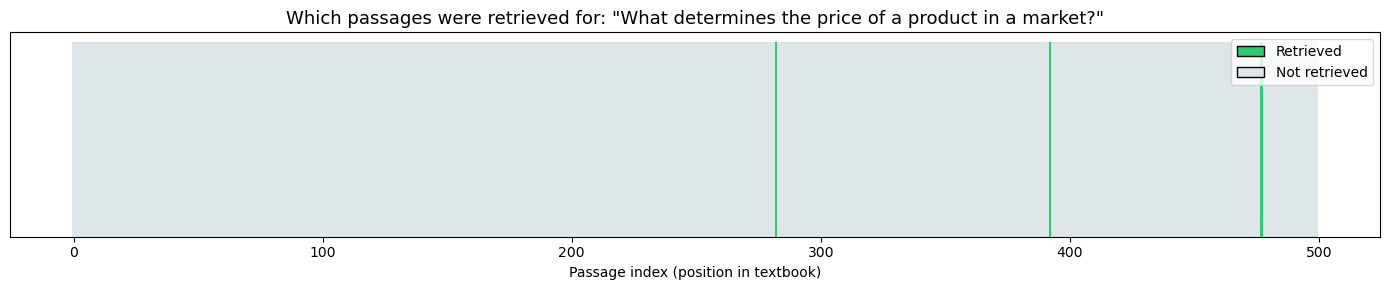
Each bar is one textbook passage. The green ones are what the search found as most relevant.
Notice they can come from anywhere in the textbook — the search is by meaning, not by position.
def ask_with_rag(question, n_chunks=3):
    """Retrieve textbook passages, then generate an answer."""
    results = search_textbook(question, n_results=n_chunks)
    retrieved_texts = [r["text"] for r in results]

    context = "\n\n".join(retrieved_texts)
    prompt = f"""Answer the question in 1 sentences using the textbook passages below.
Include specific details and numbers from the passages.

Textbook passages:
{context}

Question: {question}

Answer (1-2 sentences):"""
    model._ctx.reset_timings()
    response = model.create_chat_completion(
        messages=[{"role": "user", "content": prompt}],
        max_tokens=150
    )
    model._ctx.print_timings()
    return response["choices"][0]["message"]["content"], results


def ask_without_rag(question):
    """Ask the model directly — no textbook, just its own knowledge."""
    prompt = f"Answer in 1 sentences: {question}"
    model._ctx.reset_timings()
    response = model.create_chat_completion(
        messages=[{"role": "user", "content": prompt}],
        max_tokens=50
    )
    model._ctx.print_timings()
    return response["choices"][0]["message"]["content"]

print("Functions defined!")
Functions defined!
# Pointed question: demands a specific number the model can't guess
test_question = "What was the world price of coffee per pound in 1993?"

answer_no_rag = ask_without_rag(test_question)
answer_rag, rag_results = ask_with_rag(test_question)

print("=" * 60)
print(f'Question: "{test_question}"')
print("=" * 60)
print()
print("WITHOUT RAG (closed-book — model guesses):")
print("-" * 60)
print(answer_no_rag)
print()
print("WITH RAG (open-book — model reads the textbook):")
print("-" * 60)
print(answer_rag)

# Fact check
print()
print("FACT CHECK — the textbook says:")
print("-" * 60)
for r in rag_results:
    if "1993" in r["text"] or "50 cents" in r["text"]:
        print(f"  {r['text'][:400].replace(chr(10), ' ')}")
        break
else:
    print(f"  {rag_results[0]['text'][:400].replace(chr(10), ' ')}")
llama_perf_context_print: load time = 39.60 ms
llama_perf_context_print: prompt eval time = 39.41 ms / 41 tokens ( 0.96 ms per token, 1040.48 tokens per second)
llama_perf_context_print: eval time = 903.54 ms / 21 runs ( 43.03 ms per token, 23.24 tokens per second)
llama_perf_context_print: total time = 977.22 ms / 62 tokens
llama_perf_context_print: graphs reused = 20
llama_perf_context_print: load time = 39.60 ms
llama_perf_context_print: prompt eval time = 39.41 ms / 41 tokens ( 0.96 ms per token, 1040.48 tokens per second)
llama_perf_context_print: eval time = 903.54 ms / 21 runs ( 43.03 ms per token, 23.24 tokens per second)
llama_perf_context_print: total time = 980.28 ms / 62 tokens
llama_perf_context_print: graphs reused = 20
Llama.generate: 15 prefix-match hit, remaining 728 prompt tokens to eval
llama_perf_context_print: load time = 39.60 ms
llama_perf_context_print: prompt eval time = 291.36 ms / 728 tokens ( 0.40 ms per token, 2498.60 tokens per second)
llama_perf_context_print: eval time = 712.31 ms / 20 runs ( 35.62 ms per token, 28.08 tokens per second)
llama_perf_context_print: total time = 1096.75 ms / 748 tokens
llama_perf_context_print: graphs reused = 19
llama_perf_context_print: load time = 39.60 ms
llama_perf_context_print: prompt eval time = 291.36 ms / 728 tokens ( 0.40 ms per token, 2498.60 tokens per second)
llama_perf_context_print: eval time = 712.31 ms / 20 runs ( 35.62 ms per token, 28.08 tokens per second)
llama_perf_context_print: total time = 1099.84 ms / 748 tokens
llama_perf_context_print: graphs reused = 19
============================================================
Question: "What was the world price of coffee per pound in 1993?"
============================================================

WITHOUT RAG (closed-book — model guesses):
------------------------------------------------------------
The world price of coffee per pound in 1993 was approximately $1.20.

WITH RAG (open-book — model reads the textbook):
------------------------------------------------------------
The world price of coffee per pound was about 50 cents in 1993.

FACT CHECK — the textbook says:
------------------------------------------------------------
  income. These families are exposed to enormous risk, because the world price of coffee bounces up and down. For  example, in 1993, the world price of coffee was about 50 cents per pound. In 1995 it was four times as high, at $2  per pound. By 1997 it had fallen by half to $1.00 per pound. In 1998 it leaped back up to $2 per pound. By 2001 it  had fallen back to 46 cents a pound. By early 2011 it r
Without RAG, the model either refuses or invents a number. With RAG, it gives the exact price.
# Another pointed question — different fact, same pattern
hard_question = "In what year did a major frost hit the Brazilian coffee crop?"

answer_no_rag_2 = ask_without_rag(hard_question)
answer_rag_2, rag_results_2 = ask_with_rag(hard_question)

print("=" * 60)
print(f'Question: "{hard_question}"')
print("=" * 60)
print()
print("WITHOUT RAG (closed-book):")
print("-" * 60)
print(answer_no_rag_2)
print()
print("WITH RAG (open-book):")
print("-" * 60)
print(answer_rag_2)
import re

print()
print("FACT CHECK — the textbook says:")
print("-" * 60)

found = False

for r in rag_results_2:
    idx = r["index"]

    # Join neighboring chunks so we don't get a sentence cut in half
    start_i = max(0, idx - 1)
    end_i = min(len(chunks), idx + 2)
    joined = " ".join(chunks[start_i:end_i])

    # Clean whitespace
    text_flat = re.sub(r"\s+", " ", joined).strip()

    # Find the key phrase (prefer frost + 1994)
    anchor = None
    if "frost" in text_flat.lower() and "1994" in text_flat:
        m = re.search(r"frost", text_flat, flags=re.IGNORECASE)
        if m:
            anchor = m.start()

    if anchor is not None:
        # Print a small passage around the match
        window = 140
        s = max(0, anchor - window)
        e = min(len(text_flat), anchor + window)

        snippet = text_flat[s:e]
        if s > 0:
            snippet = "..." + snippet
        if e < len(text_flat):
            snippet = snippet + "..."

        print(snippet)
        found = True
        break

if not found:
    print("(Couldn’t find a nearby frost/1994 passage in retrieved chunks.)")
============================================================
Question: "In what year did a major frost hit the Brazilian coffee crop?"
============================================================
WITHOUT RAG (closed-book):
------------------------------------------------------------
A major frost hit the Brazilian coffee crop in the year 1984.
WITH RAG (open-book):
------------------------------------------------------------
In 1994, a major frost hit the Brazilian coffee crop.
FACT CHECK — the textbook says:
------------------------------------------------------------
... only about 0.3; that is, a 10% rise in the price of coffee leads to a decline of about 3% in the quantity of coffee consumed. When a major frost hit the Brazilian coffee crop in 1994, coffee supply shifted to the quantity of coffee consumed. When a major frost hit the Brazilian ...
Does More Context Help?
We can control how many passages to retrieve. Let’s compare 1 passage vs. 3 passages for the same question.
context_question = "What happens when the government sets a price floor?"

answer_1, results_1 = ask_with_rag(context_question, n_chunks=1)
answer_3, results_3 = ask_with_rag(context_question, n_chunks=3)
print("=" * 60)
print(f'Question: "{context_question}"')
print("=" * 60)
print()
print("WITH 1 PASSAGE:")
print(f"  Retrieved: chunk {results_1[0]['index']} (similarity {results_1[0]['similarity']:.3f})")
print(f"  Answer: {answer_1}")
print()
print("WITH 3 PASSAGES:")
for r in results_3:
    print(f"  Retrieved: chunk {r['index']} (similarity {r['similarity']:.3f})")
print(f"  Answer: {answer_3}")
============================================================
Question: "What happens when the government sets a price floor?"
============================================================
WITH 1 PASSAGE:
Retrieved: chunk 173 (similarity 0.580)
Answer: When the government sets a price floor, it means that the price of some necessary good or service cannot fall below a certain level. For example, in 2005 during Hurricane Katrina, the price of bottled water increased above $5 per gallon. As a result, many people called for price controls to prevent the price from rising too high.
WITH 3 PASSAGES:
Retrieved: chunk 173 (similarity 0.580)
Retrieved: chunk 172 (similarity 0.569)
Retrieved: chunk 190 (similarity 0.564)
Answer: When the government sets a price floor, it guarantees a certain price for farmers to sell their crops. This transfer of consumer surplus to producers creates deadweight loss, as it blocks some transactions between buyers and sellers. Removing such barriers will increase the economy's social surplus.
# Side-by-side visualization
fig, axes = plt.subplots(1, 2, figsize=(14, 3))

for ax, res, label in [(axes[0], results_1, "1 Passage"), (axes[1], results_3, "3 Passages")]:
    id_set = set(r["index"] for r in res)
    bar_colors = ["#2ecc71" if i in id_set else "#dfe6e9" for i in range(len(chunks))]
    ax.bar(range(len(chunks)), [1] * len(chunks), color=bar_colors, edgecolor="none", width=1.0)
    ax.set_title(label, fontsize=14, fontweight="bold")
    ax.set_xlabel("Passage index")
    ax.set_yticks([])

legend_elements = [
    Patch(facecolor="#2ecc71", edgecolor="black", label="Retrieved"),
    Patch(facecolor="#dfe6e9", edgecolor="black", label="Not retrieved")
]
axes[1].legend(handles=legend_elements, loc="upper right")

plt.suptitle(f'1 vs 3 passages: "{context_question}"', fontsize=13, y=1.02)
plt.tight_layout()
plt.show()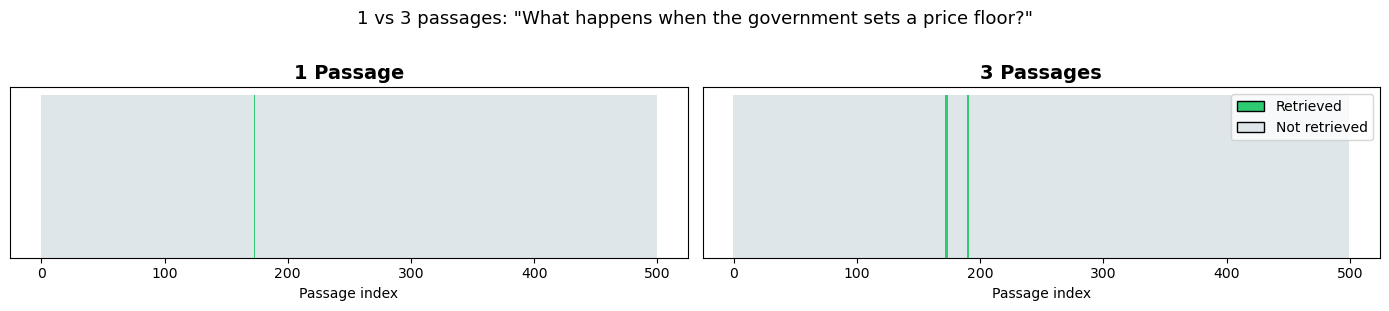
More passages = more information, but too many can confuse a small model or hit the context window limit. 3 chunks is a good default.
The Full Pipeline
fig, axes = plt.subplots(1, 5, figsize=(20, 4))

panels = [
    ("1. Textbook", f"OpenStax\nMicroeconomics 3e\n{len(ds)} raw passages", "#AED6F1", "#2980B9"),
    ("2. Filter", f"{len(chunks)} clean chunks\nremoved boilerplate", "#A9DFBF", "#27AE60"),
    ("3. Embed", f"{chunk_embeddings.shape[0]} vectors\n{chunk_embeddings.shape[1]} dimensions each", "#F9E79F", "#F39C12"),
    ("4. Retrieve", f"Top-k passages\nby cosine similarity", "#F5CBA7", "#E67E22"),
    ("5. Answer", f"Qwen2 1.5B\ncontext + question", "#D7BDE2", "#8E44AD"),
]

for ax, (title, text, facecolor, edgecolor) in zip(axes, panels):
    ax.text(0.5, 0.5, text, ha="center", va="center", fontsize=12,
            bbox=dict(boxstyle="round,pad=0.8", facecolor=facecolor,
                      edgecolor=edgecolor, linewidth=2),
            transform=ax.transAxes)
    ax.set_title(title, fontsize=13, fontweight="bold")
    ax.axis("off")

for i in range(4):
    fig.text(0.19 + i * 0.19, 0.5, "\u2192", fontsize=30, ha="center", va="center")

plt.suptitle("The RAG Pipeline: Textbook to Study Buddy", fontsize=16, fontweight="bold", y=1.05)
plt.tight_layout()
plt.show()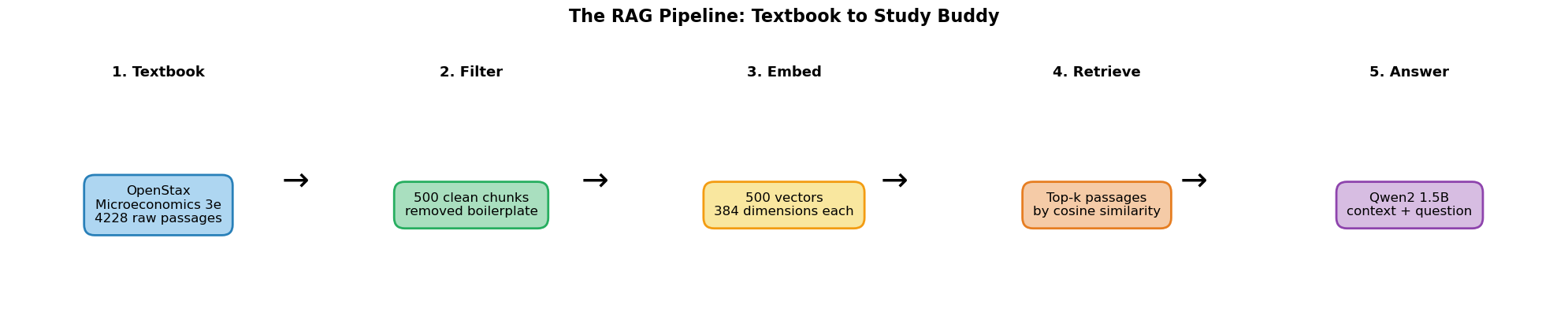
Try It Yourself!
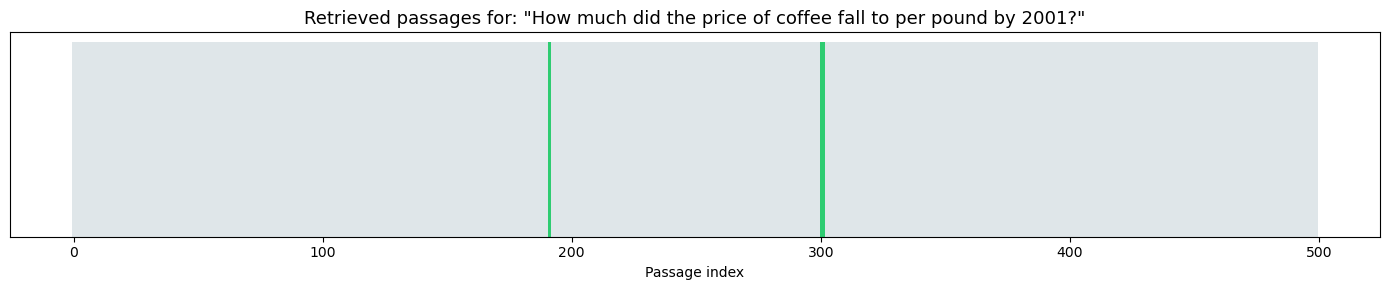
Change the question below. The more specific, the better RAG works:
"How much did the price of coffee fall to per pound by 2001?""What was the world price of coffee per pound in 1998?""How does a perfectly competitive firm decide what quantity to produce?""What is the relationship between elasticity and total revenue?"
# CHANGE THIS QUESTION!
my_question = "How much did the price of coffee fall to per pound by 2001?"

my_no_rag = ask_without_rag(my_question)
my_rag, my_results = ask_with_rag(my_question, n_chunks=3)

print("=" * 60)
print(f'Your question: "{my_question}"')
print("=" * 60)
print()
print("WITHOUT textbook:")
print("-" * 60)
print(my_no_rag)
print()
print("WITH textbook (RAG):")
print("-" * 60)
print(my_rag)
print()
print("FACT CHECK — the textbook says:")
print("-" * 60)
print(f"  {my_results[0]['text'][:400].replace(chr(10), ' ')}")

# Visualize retrieval
fig, ax = plt.subplots(figsize=(14, 3))
retrieved_set = set(r["index"] for r in my_results)
bar_colors = ["#2ecc71" if i in retrieved_set else "#dfe6e9" for i in range(len(chunks))]
ax.bar(range(len(chunks)), [1] * len(chunks), color=bar_colors, edgecolor="none", width=1.0)
ax.set_title(f'Retrieved passages for: "{my_question}"', fontsize=13)
ax.set_xlabel("Passage index")
ax.set_yticks([])
plt.tight_layout()
plt.show()
============================================================
Your question: "How much did the price of coffee fall to per pound by 2001?"
============================================================
WITHOUT textbook:
------------------------------------------------------------
The price of coffee fell to approximately $0.25 per pound by 2001.
WITH textbook (RAG):
------------------------------------------------------------
By 2001, the price of coffee had fallen back to $1.31 per pound.
FACT CHECK — the textbook says:
------------------------------------------------------------
income. These families are exposed to enormous risk, because the world price of coffee bounces up and down. For example, in 1993, the world price of coffee was about 50 cents per pound. In 1995 it was four times as high, at $2 per pound. By 1997 it had fallen by half to $1.00 per pound. In 1998 it leaped back up to $2 per pound. By 2001 it had fallen back to 46 cents a pound. By early 2011 it r
RAG Isn’t Perfect — and That’s the Point
You may notice that even with the textbook passage in front of it, the model sometimes gets facts wrong — misquoting a number or mixing up details. That’s not a bug in RAG. It reveals an important distinction:
A RAG pipeline has two parts that can each fail independently:
| Step | What it does | What can go wrong |
|---|---|---|
| Retrieval | Find the right passage | Wrong passage retrieved (bad embeddings, bad query) |
| Generation | Read the passage and answer | Model misreads or hallucinates despite having the right text |
Our 1.5B parameter model is small — it sometimes struggles to extract the right detail from a passage, even when the answer is right there. A larger model (7B, 70B, or a cloud API like GPT-4) would do better at the generation step. But the retrieval step works the same regardless of model size — that’s the part we built in this notebook.
Summary
| What | How |
|---|---|
| Data | OpenStax Microeconomics 3e, loaded from Hugging Face |
| Vector store | Embeddings (numpy arrays) + cosine similarity search |
| Why RAG matters | A small model + the right passage beats a larger model guessing |
| Pipeline | Textbook → Filter → Embed → Search → Generate |
The RAG series:
Part 1 (Pipeline Visualizer): Word matching + basic RAG concept
Part 2 (Embeddings Visualizer): Semantic similarity with embeddings
Part 3 (Vector Store): Real textbook + study buddy