The story we will follow
You are helping secure an online store checkout page. A customer types card details and clicks Pay.
Your job is to explain:
what cryptography protects this flow today
what RSA is doing in that picture
why quantum computing changes long-term risk planning
Visual anchor: what you should picture
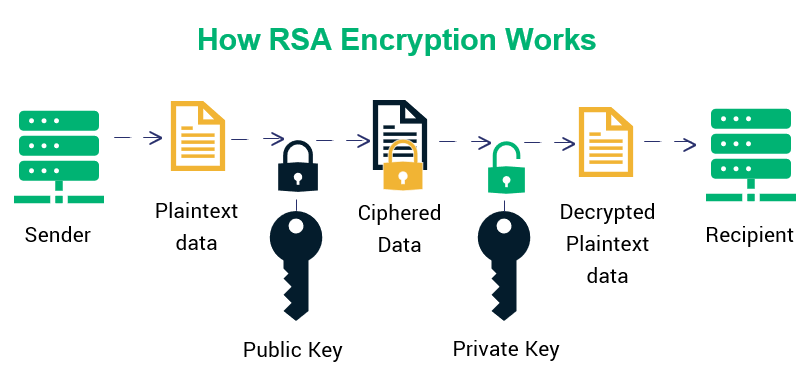
We will return to this same checkout story in every section, so concepts do not feel disconnected.
Learning Goals
By the end, you should be able to:
explain hashing vs encryption without mixing them up
walk through a toy RSA example from key creation to decryption
describe where RSA fits in modern web security
explain why quantum computing creates migration pressure
recommend one practical next step for a security team
Part 1: Hashing warm-up
At checkout, passwords and data fingerprints often use hashing, not encryption.
Prediction pause: Before running code, predict what will happen if we change only one character in input text.
import hashlib

def sha256_hex(text):
    return hashlib.sha256(text.encode('utf-8')).hexdigest()

samples = ["card1234", "card1235", "Card1234"]
for s in samples:
    print(f"{s:10} -> {sha256_hex(s)}")
Quick check (1-2 sentences)
Why is this avalanche behavior useful for integrity checking?
Why would encryption (not hashing) still be needed for card data in transit?
Type your answer here
Part 2: RSA
Step A: The RSA algorithm (general form)
Choose two prime numbers: and
Compute:
Compute the coprime count:
Choose a public exponent such that:
(gcd = greatest common divisor)
Compute private exponent such that:
Public key is , private key is
Encrypt message :
Decrypt ciphertext :
Step B: Worked example (small numbers for learning)
Let:
,
choose
Now compute:
Find such that:
This gives:
So:
public key:
private key:
If message is :
Decrypt:
So the original message is recovered.
from utils import generate_toy_rsa, rsa_encrypt, rsa_decrypt

params = generate_toy_rsa(p=61, q=53, e=17)
print('n =', params['n'])
print('phi(n) =', params['phi_n'])
print('public key =', params['public_key'])
print('private key =', params['private_key'])

m = 42
c = rsa_encrypt(m, params['e'], params['n'])
restored = rsa_decrypt(c, params['d'], params['n'])
print('message =', m)
print('ciphertext =', c)
print('decrypted =', restored)
Part 3: Intermediate RSA steps
We still want transparency. This cell prints the key intermediate rows so you can trace exactly what happened.
Prediction pause: Which changes when message changes: keys, ciphertext, decrypted value, or all three?
from utils import rsa_steps

message = 42
info = rsa_steps(message)

print('--- key setup ---')
print('p, q =', info['p'], info['q'])
print('n =', info['n'], 'phi(n) =', info['phi_n'])
print('e =', info['e'], 'd =', info['d'])

print('\n--- modular inverse trace (first 5 rows) ---')
for i, row in enumerate(info['inverse_rows'][:5]):
    print(i, row)

print('\n--- encryption square-and-multiply trace ---')
for i, row in enumerate(info['encrypt_rows']):
    print(i, row)

print('\n--- decryption square-and-multiply trace ---')
for i, row in enumerate(info['decrypt_rows']):
    print(i, row)

print('\nFinal: m -> c -> m\' =', info['message'], '->', info['ciphertext'], '->', info['recovered'])
Pair activity (5-7 min)
In pairs, change message to two new values and answer:
Which rows changed in encryption trace?
Which values stayed constant across runs?
Why is this toy demo educational but not secure in production?
Part 4: Where RSA fits in checkout security
Use this statement carefully:
RSA is often used for identity/signature/certificate trust paths.
Bulk data transfer is typically protected by symmetric session keys.
So the checkout flow depends on a stack of cryptographic pieces, not one algorithm alone.
Part 5: Quantum risk
If large fault-tolerant quantum computers become practical, RSA assumptions can weaken dramatically.
Security teams worry about harvest now, decrypt later:
attackers can steal encrypted traffic today
they may decrypt it years later if crypto breaks
Reflection check
Name one kind of data that must stay secret long enough to make this a current planning issue.
Type your answer here
Part 6: What should teams do? (PQC vs QKD)
Post-quantum cryptography (PQC): software/protocol migration path for existing systems
Quantum key distribution (QKD): specialized hardware/link environments
For most organizations, first action is crypto-agility + PQC migration planning.
Exit memo (6-8 sentences)
You are advising an online retailer. Write a short memo that answers:
What is the main cryptographic risk over the next decade?
What should be migrated first?
Why is waiting risky?
How would you explain this to non-technical leadership?